Technology
Every XOP is active, DSP-controlled and measured — not because it is fashionable, but because it is the only honest way to make a loudspeaker tell the truth at any volume.
Active & DSP-controlled
Almost every high-end loudspeaker in the world is passive: one stereo amplifier drives a network of coils, capacitors and resistors that carves the signal into bands after the fact. It works, but it throws away power, blurs timing, and leaves the driver at the mercy of whatever amplifier the owner happens to bolt on.
We do the opposite. Each driver has its own dedicated amplifier channel, and the crossover is computed in the digital domain before a single watt reaches a voice coil. Nothing is left to chance, and nothing is left on the table.
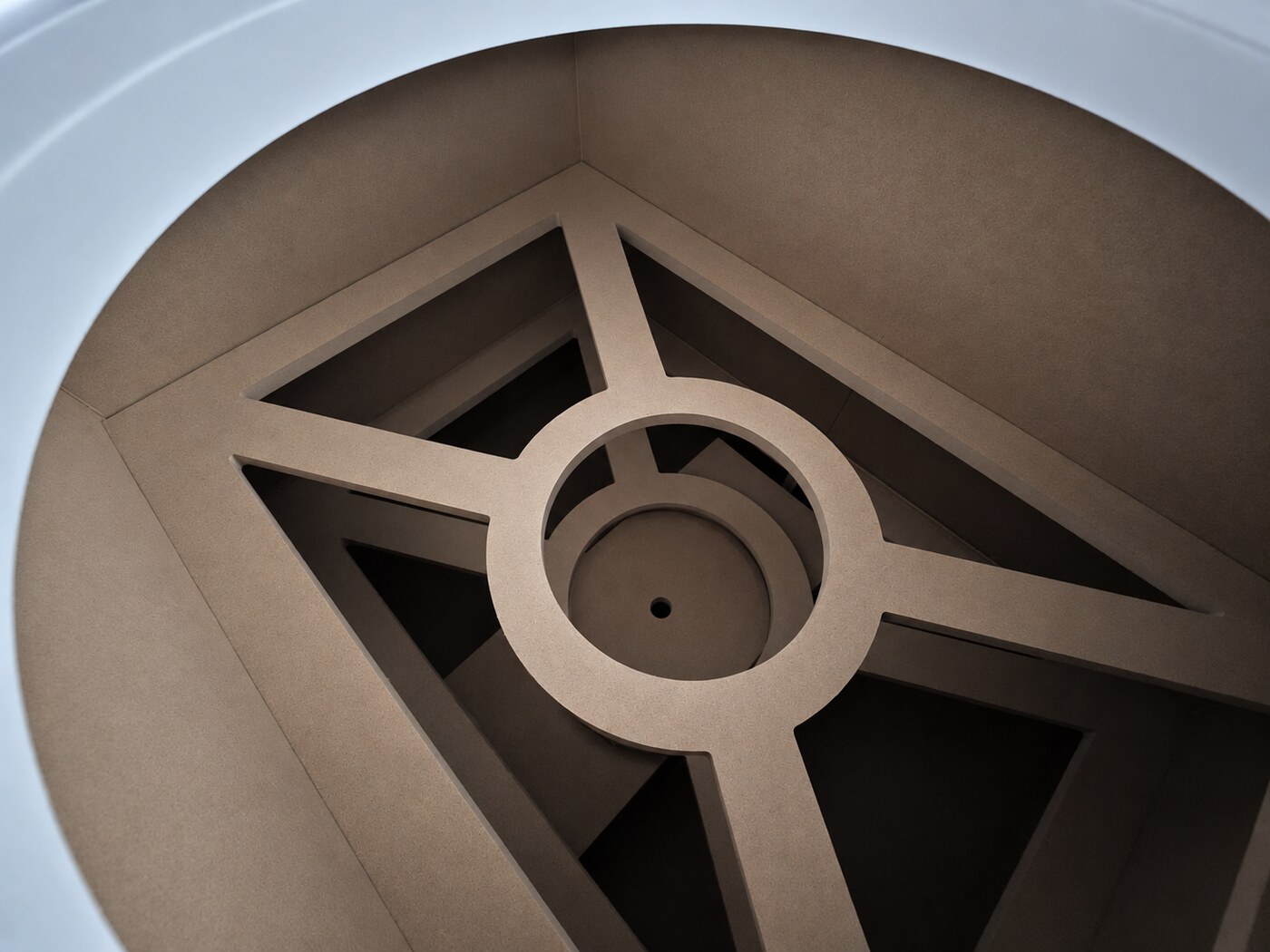
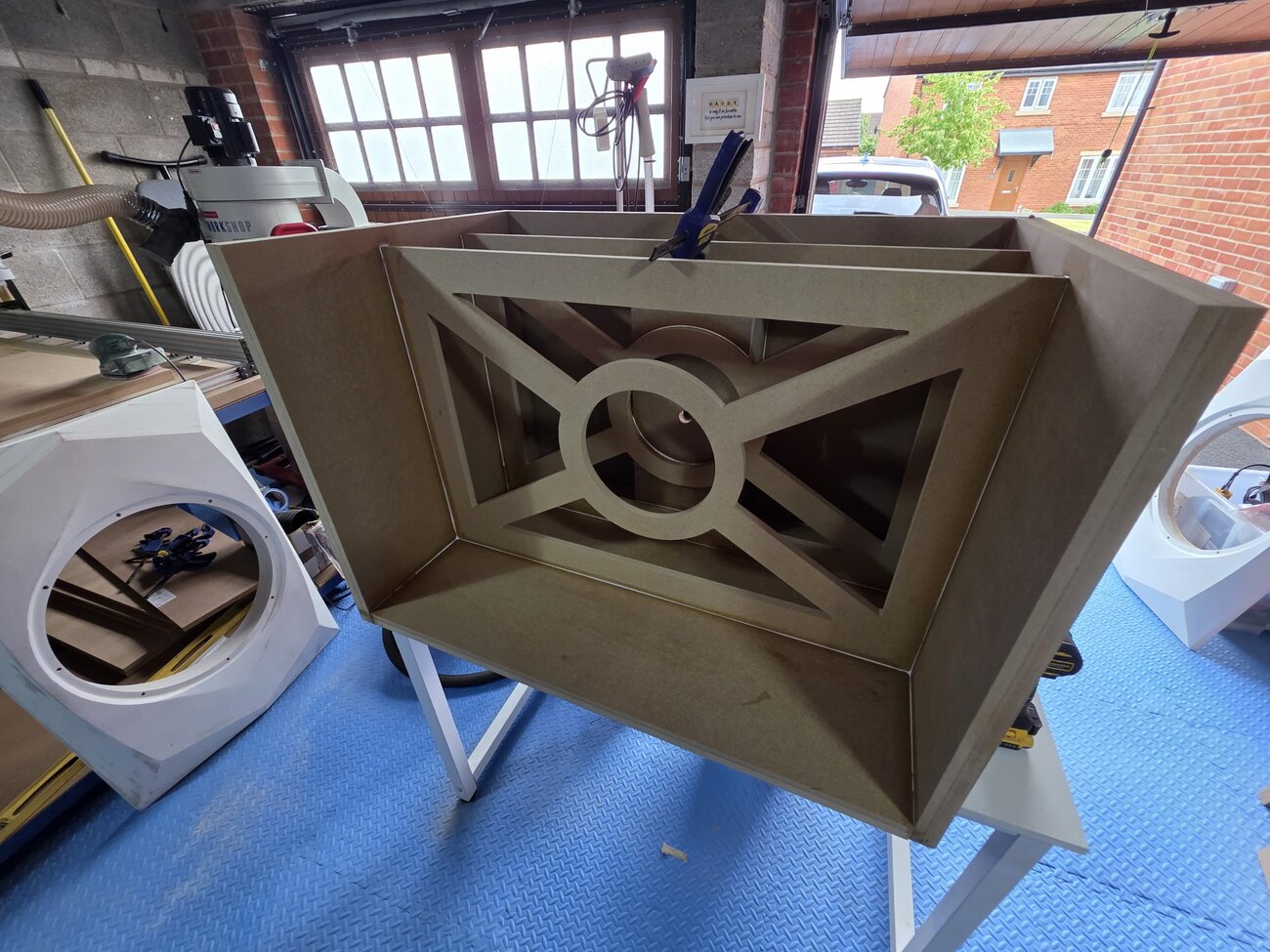
Cabinet engineering
A loudspeaker cabinet has one job: add nothing. Ours are cut on our own CNC from dense MDF, with a faceted baffle built from two 40 mm halves glued into one solid 80 mm face — thick, inert, and shaped to control diffraction rather than cause it.
Inside, twin ring-hub X-braces lock all four walls at the driver's centre of mass, and — on the powered models — a sealed pod isolates the amplifier from the working air, so the alignment stays exactly as designed. The result is a structure you can drive hard and never hear.
The crossover
A passive crossover trades one problem for another; a digital one need not. Ours splits the band with fourth-order Linkwitz-Riley slopes and can correct phase and time in the same pass — so the drivers arrive together, and the music arrives whole.
Steep, symmetrical slopes keep each driver in the band it does best and out of the ones it doesn't — clean hand-offs, no overlap haze.
The DSP corrects the arrival time of each driver so the wavefront is coherent at the listening seat — imaging you can walk around.
Room-matched presets adapt the speaker to placement — near a wall, out in the room, or flat reference — without touching the cabinet.
On the subwoofers, linear-phase FIR filtering extends the low end below the natural roll-off without unsealing the box.
The drivers
We don't build to a budget of parts; we choose the finest driver for each job and design the cabinet and DSP to suit it. These are among the most respected transducers made anywhere.
A 25 mm BlieSMa T25D diamond dome — the hardest, stiffest dome made, its first breakup far beyond hearing. Extended, uncoloured, effortless treble.
A 6.5 ″ Purifi PTT6.5 — engineered to among the lowest distortion ever measured in a driver of its kind. Uncanny clarity, true timbre.
A high-output 15 ″ pro driver — 98 dB efficient, clean and uncompressed where lesser cones harden. Scale without strain.
A 21 ″ Eminence NSW6021 on a 2,500-watt neodymium motor with 21 mm of clean travel — displacement that pressurises a real room.
Anyone can print a flat line on a brochure. We do something almost no one in this field does: every cabinet is characterised before it leaves the workshop, and its own measured data travels with it — in a build diary that records the honest story of its making, mistakes included. You don't take our word for how your speaker behaves. You get the plot.
The philosophy on this page, made real in three loudspeakers.